Water tank monitoring for hotels and villas: the options compared
Short answer. A small hotel or villa has five realistic choices: staff checks, float switches with a pump controller, consumer Wi-Fi tank sensors, a do-it-yourself or industrial system run by someone technical, and an installed, supported service such as Kanari (large resorts add a building management system). Float switches are the cheapest way to protect a pump. A consumer sensor is the cheapest way to see one tank's level on your phone. An installed service costs the most, but adds pump control, leak alerts and someone to call. Kanari wrote this page and sells the last option.
Who wrote this: Kanari, a Saint Lucia company that sells and installs one of the options below. We've tried to be fair, and to say plainly where something else is the better buy.
| Option | Rough cost | What you see | Pump control | Who keeps it running |
|---|---|---|---|---|
| Staff checks (dipstick, sight tube) | Staff time | One reading, when someone looks | By hand | Your staff |
| Float switches and a pump controller | Tens of dollars a float, plus an electrician | Nothing remotely | Automatic at fixed float heights | Your electrician |
| Consumer Wi-Fi tank sensor | Tens to a few hundred dollars a tank, bought online | One tank's level in an app | Usually none | You |
| DIY or industrial IoT | Cheap parts for DIY; industrial sensors plus a platform subscription and an integrator | Whatever is built | Possible; you design the safety | Whoever built it |
| Building management system | Quoted per project; usually the most expensive | The whole plant, on site | Yes | A controls contractor |
| Kanari | Installed from US$1,710 (villa) to about US$5,520 (30-room hotel), plus US$89 to US$749 a month | Every tank, meter and pump, on phone and laptop, with a month of history | From your phone in under 10 seconds, and automatic at your levels | Kanari, with alerts to your team |
Staff checks
Someone climbs up with a dipstick, or reads a sight tube on the side of the tank, a few times a day. It costs nothing extra and works on any tank. It misses everything between checks, and nights most of all, which is when city water often comes and leaks are easiest to see.
Good for: a very small property with someone always on site.
Float switches and a pump controller
A float in the cistern and one in the roof tank, wired to the pump starter, so the pump runs when the top tank is low and stops when the cistern is low. Cheap, works without the internet, and any electrician can fit it. But you can't see anything from your phone, a float stuck in the up position fails silently, and it can't tell you about leaks.
Good for: every property, as a hard cut-off to protect the pump, even alongside monitoring.
Consumer Wi-Fi tank sensors
An ultrasonic or pressure sensor on one tank that shows its level in a phone app, sold online. Cheap per tank. Most need Wi-Fi at the tank, which underground cisterns and tanks up the hill often don't have, and ultrasonic sensors struggle in closed concrete cisterns (sensors compared). Each usually has its own app, and few control a pump.
Good for: a villa with one tank in Wi-Fi range, where you only want to see the level.
DIY or industrial IoT
Microcontroller boards, open-source home automation and chat-app alerts on one end; industrial cellular or long-range radio sensors with a cloud platform on the other. Flexible and capable. Someone has to design it, secure it, look after it, and decide what the pumps do when the internet drops. Switching mains-powered pumps is an electrician's job either way.
Good for: a property with a technical person on hand, or a large site with a systems integrator.
A building management system
Controllers in the plant room, run by a controls contractor, often covering air conditioning and power as well as water. Thorough, and built for properties with engineers on site.
Good for: large resorts that already have one, or are building.
Kanari
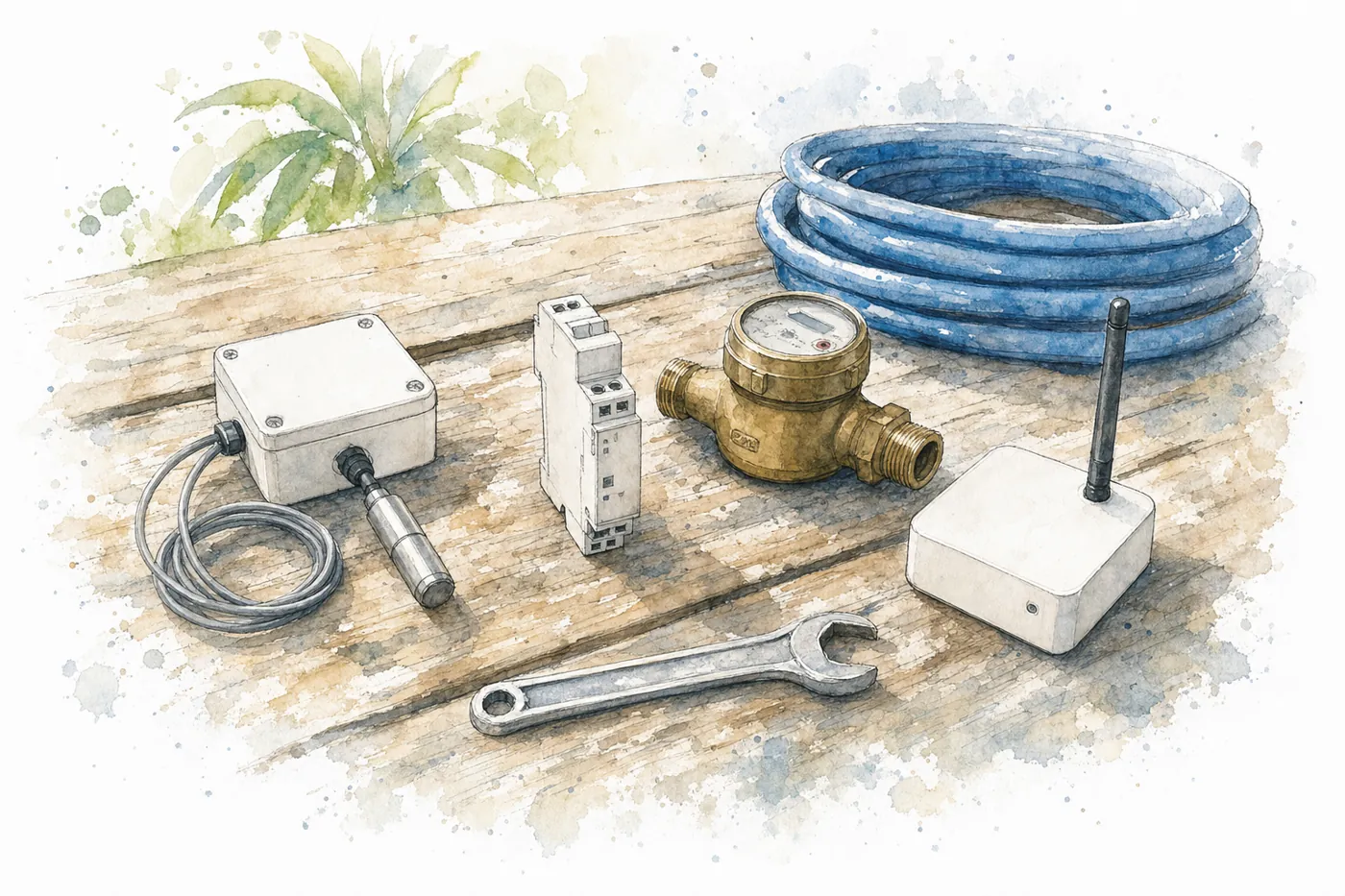
A level sensor in each tank, meters on the lines that matter, a smart switch on each pump circuit and a hub, fitted by our own installer and electrician. One dashboard for every tank and pump, pumps that start and stop at your levels, dry-run and loss-of-contact shut-off, and WhatsApp alerts to your team for leaks at night, tanks dropping with the pumps off, and pumps that should have started. Monthly plans include batteries, support and a hardware warranty. See features and prices, or try the live demo.
When Kanari isn't the right choice
- You only need to protect a pump. A float switch does that for tens of dollars.
- You have one tank in Wi-Fi range and only want to see its level. A consumer sensor is cheaper.
- You need water quality, such as chlorine, pH or turbidity. We don't measure it.
- You want a person watching your tanks around the clock. We don't run a control room: the system acts on its own, and the alerts go to your team.
- You want no monthly fee. Our plans run for at least 12 months.
- You already have a building management system and engineers on site. Add the tanks to it.
We're also new: Kanari started in 2026. Ask us anything you'd ask a bigger supplier.
Questions to ask any supplier
- Who installs it, and who comes when it fails?
- What do the pumps do if the internet drops, and after a power cut?
- How does it stop a pump running dry?
- Does each tank need Wi-Fi, or does it talk to a hub?
- Can I buy a replacement part on my island, or online, without waiting for the supplier?
- Who gets the alerts, and how: app, text, WhatsApp, a phone call?
- How long is the contract, and what happens to the kit if I stop?
Want this done for you?
Sensors in your tanks, pumps that run themselves, alerts when something needs a person.
Book a visit or call